What Is IoPT? A Deep Dive Into Identity-Oriented Psychotrauma Therapy
Identity-oriented Psychotrauma Therapy (IoPT) is a therapeutic approach that often sparks curiosity, reflection, and many questions. Some people discover IoPT for the first time and wonder what it is and how it works. Others may already have experience with the method and would like to better understand essential parts of the underlying theory and therapeutic method such as the split structure of the psyche, the Intention Method or resonance.
In this article, I will explore the foundations of IoPT, explain the therapeutic process step by step, and answer some of the questions I am most frequently asked by clients and readers. My hope is that this guide offers both a practical introduction for those who are new to IoPT and a deeper understanding for those who would like to explore the method in more detail.
To better understand why IoPT works in the way it does, it is helpful to begin with the foundation of the approach: its understanding of trauma. This perspective helps explain how traumatic experiences can shape our identity and why reconnecting with fragmented parts of ourselves plays such an important role in the healing process.
What do we mean by trauma?
The word trauma is often associated with catastrophic events such as severe accidents, war, or natural disasters. While these experiences can certainly be traumatic, trauma is not defined by the event itself. Instead, it describes what happens within us when an experience overwhelms our capacity to cope and cannot be fully processed and integrated.
Trauma can arise when something is too much, too little, too sudden, or continues for too long. It may also develop when we are left without the time, support, protection, emotional attunement, or internal and external resources needed to process what happened. From an IoPT perspective, we speak of trauma when an overwhelming experience leads to a fragmentation of the psyche. What matters is that the experience was not simply difficult or painful, but so overwhelming that parts of our I became separated from one another in order to cope with what happened.
This is particularly relevant during early childhood, when our nervous system is still developing and we depend entirely on our caregivers for safety, regulation, and connection.
What is Identity-oriented Psychotrauma Theory and Therapy (IoPT)?
Identity-oriented Psychotrauma Theory and Therapy (IoPT) combines a theoretic model and a deeply trauma-informed therapeutic approach both developed by Professor Dr. Franz Ruppert, a German psychologist and psychotherapist. It is based on established trauma theories, attachment research, and Ruppert's own work on trauma, identity development, and constellation work.
At the heart of IoPT lies the understanding that traumatic and overwhelming experiences, particularly those occurring during pregnancy, birth, infancy, and childhood, can profoundly influence the development of our identity, our relationships, and the way we experience ourselves and the world around us. IoPT offers an approach for inner self-exploration to better understand the root causes of our symptoms and challenges. The aim is to support people in reconnecting with themselves, integrating unresolved trauma, and strengthening their capacity for self-awareness, healthy relationships, and authentic living.
One of the central concepts in IoPT is Franz Ruppert's model of the split psyche after traumatization (see picture below). According to this model, overwhelming experiences can lead to a psychological fragmentation. This means that rather than remaining integrated as a unified whole, the psyche organizes itself into different inner parts that each serve a particular function. This is a normal survival response and reflects the remarkable capacity of our human psyche to protect itself under overwhelming circumstances.
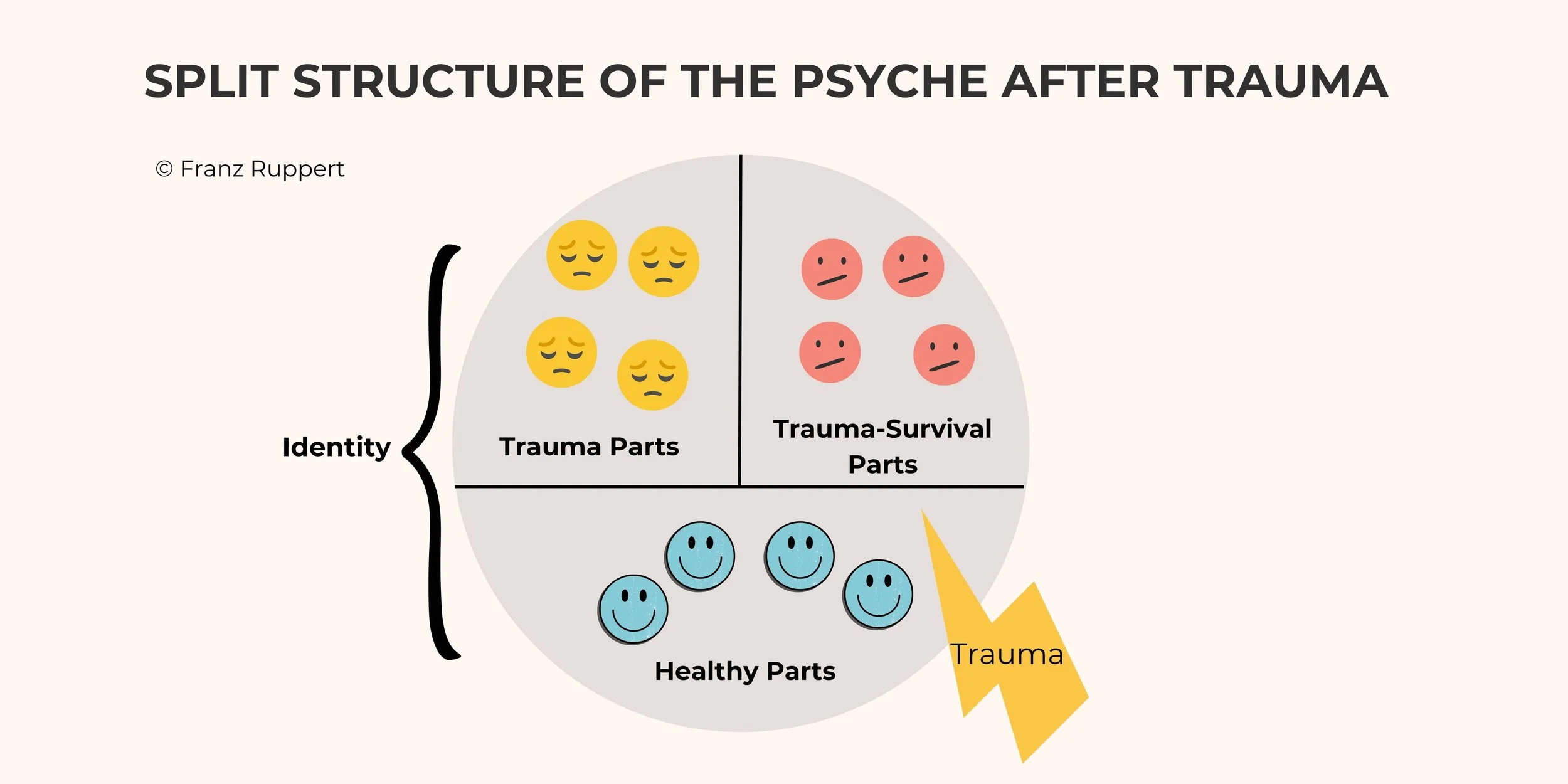
IoPT categorizes three types of inner parts: healthy parts, survival parts, and trauma parts. Although we describe them separately, they are interconnected aspects of the same person that developed in response to traumatic life experiences.
Trauma Parts
Trauma parts hold the overwhelming emotions, bodily sensations, and implicit memories connected to experiences that could not be processed at the time they occurred. Because these experiences remain unresolved, trauma parts often stay connected to the developmental stage at which the trauma happened.
When they become activated or triggered, we may suddenly experience intense emotions or physical sensations that seem disproportionate to the present situation. These can include feelings like helplessness, fear, sadness, despair, hopelessness, anger, panic, shame, or deep loneliness. Often, there is little conscious awareness that these reactions are connected to our earlier life experiences. Shifting back and forth into trauma parts is a normal and understandable response of our psyche and nervous system.
Survival Parts
Survival parts develop to protect us from becoming overwhelmed by the pain carried within the trauma parts. Their primary task is to help us function in daily life and maintain attachment, particularly during childhood when our survival depended on our caregivers.
They often achieve this by suppressing, distracting from, denying, or minimizing traumatic experiences and the emotions and sensations connected to them. Many strategies that once helped us survive can continue into adulthood, even when they are no longer beneficial.
Common Survival strategies are for example:
perfectionism, people pleasing, controlling behaviour, emotional numbing, dissociation, identification with others feelings/thoughs/behavioural patterns, overworking, excessive responsibility, addictions, compulsive behaviours, self-harm, avoiding emotions or conflict, depression, co-dependency
Healthy Parts
Healthy parts represent the aspects of ourselves that remain connected to life, growth, and authentic development. They allow us to stay present with what is happening in the here and now, to reflect on our experiences, and to respond rather than react.
Healthy parts (or the healthy I) help us recognize our own needs, express emotions appropriately, set healthy boundaries, take responsibility for ourselves, and engage in genuine relationships. They are naturally curious, compassionate, open to learning, and capable of integrating new experiences.
IoPT therapy aims to strengthen these healthy parts so they can gradually reconnect with and integrate the experiences held by the trauma parts, while recognizing and understanding the survival parts.
The Intention Method and resonance
One of the most defining characteristics of IoPT therapy is the Intention Method developed by Professor Dr. Franz Ruppert. Every self-encounter (resonance process) starts with a personally formulated intention by the client. This is an essential aspect of the therapeutic approach, as it supports the client in gently strengthening a sense of healthy autonomy, something that we often lose with trauma.
An intention is usually a short sentence, question or a few selected words that express what the client wishes to explore. This may relate to a recurring life pattern, limiting belief, a difficult emotion, a relationship, a symptom, or simply a desire to better understand themselves. The only ‘‘rule’’ when formulating an intention is that it needs to include the ‘‘I’’, as this is the central reference point in our psyche. Some examples of intentions are:
I feel disconnected from myself.
I want to be myself.
Why can I not sleep at night?
I pain shoulder
I panic
Within IoPT, every word of an intention is understood to have a neuronal connection to our unconscious. Through resonance, these words can provide access to implicit memories, emotions, body sensations, beliefs, and inner dynamics that may not yet be available to our conscious awareness.
Once the intention has been formulated, the client selects up to three elements of the intention that they wish to explore during the self-encounter. An element can be a word or even a punctuation mark from the intention. These selected elements become the starting points for the resonance process.
Within IoPT, resonance refers to our human capacity to access unconscious inner experiences beyond conscious thinking. Rather than analysing, interpreting, or consciously creating an explanation, resonance allows spontaneous experiences to emerge in relation to the selected elements of the intention. These may include emotions, body sensations, impulses, movements, images, memories, or thoughts.
In group sessions, this process takes place through resonance with other participants. The client chooses resonators for the selected elements of their intention, and these participants intuitively describe what arises within them without needing to receive information about the client's personal story beforehand.
In individual sessions, the client works through self-resonance. Using their own body, sensations, emotions, and inner experiences, often supported by floor markers or objects, they explore the selected elements of their intention together with the therapist.
Although the process looks different in individual and group settings, the underlying principle remains the same: resonance provides access to unconscious aspects of the client's inner world, allowing previously less conscious parts, experiences, and inner dynamics to become visible and explored.
Unlike many forms of talk therapy, where experiences are primarily described through language, resonance creates an embodied way of exploring our unconscious psychological processes, suppressed inner parts and even preverbal and prenatal experiences.
For more information on resonance and constellation work, please visit my previous blog article.
Understanding the "I" in IoPT
One of the most common questions people have when learning about IoPT is: "What exactly is my I?"
Within IoPT, the I represents our identity and our sense of self. It is the central reference point of our psyche, the experience of being ourselves, of having our own wants & desires, thoughts, feelings, needs, boundaries, and relationship with the world around us. The I is what allows us to experience ourselves as a unique individual and to recognize: "This is me. This is what I feel. This is what I need. This is what matters to me."
When we experience traumatizing situations that we cannot fully process and integrate, especially during early childhood or even prenatal, our identity becomes fragmented as a survival response. In IoPT, this is described as the split structure of the psyche. The healthy parts, survival parts, and trauma parts are understood as different fragmented aspects of the I that developed in response to traumatic experiences.
The below illustrations demonstrate two possible examples of how the psyche may become fragmented following traumatic experiences. Every person's inner world is unique, and the proportions shown are intended purely as a visual aid to help understand the IoPT model.
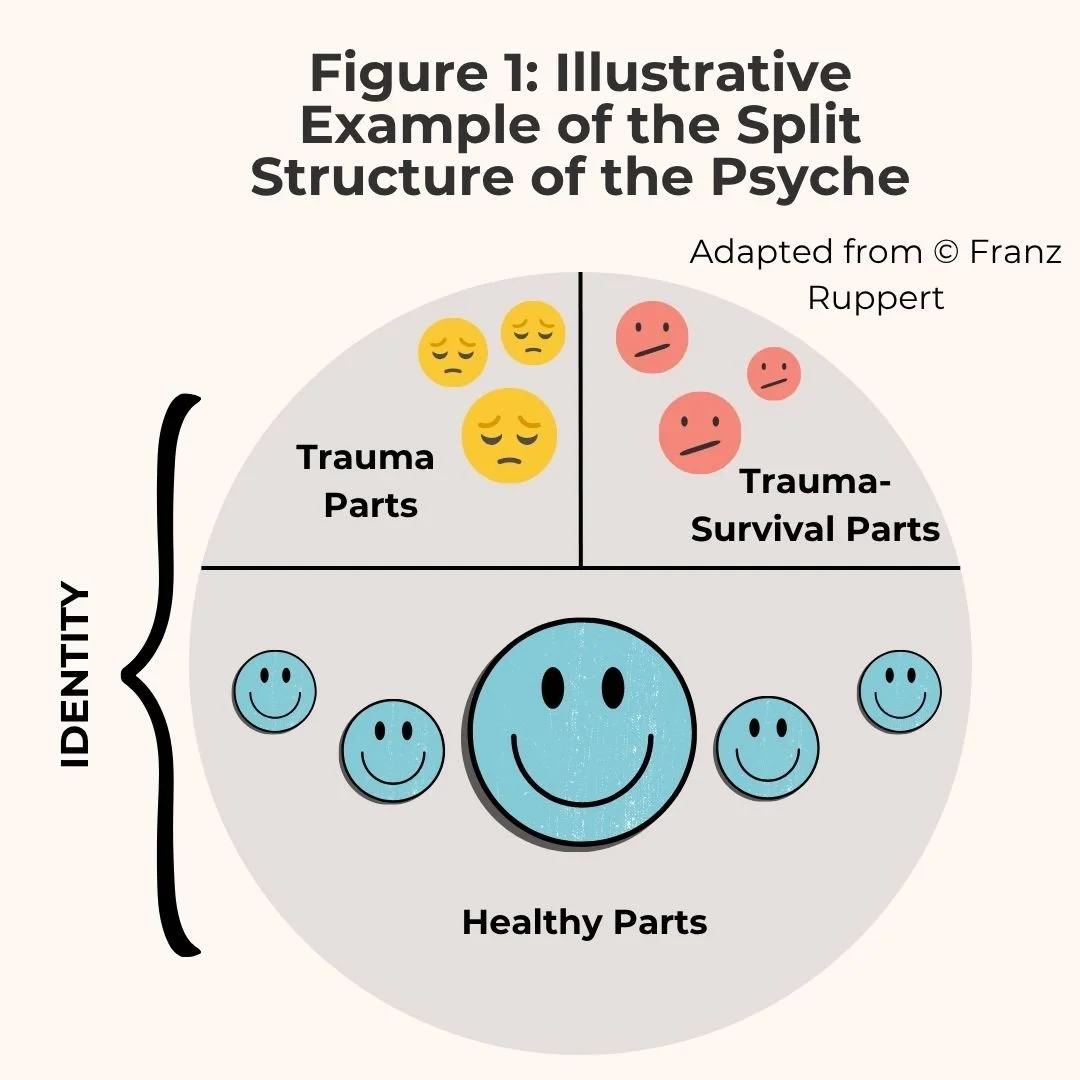
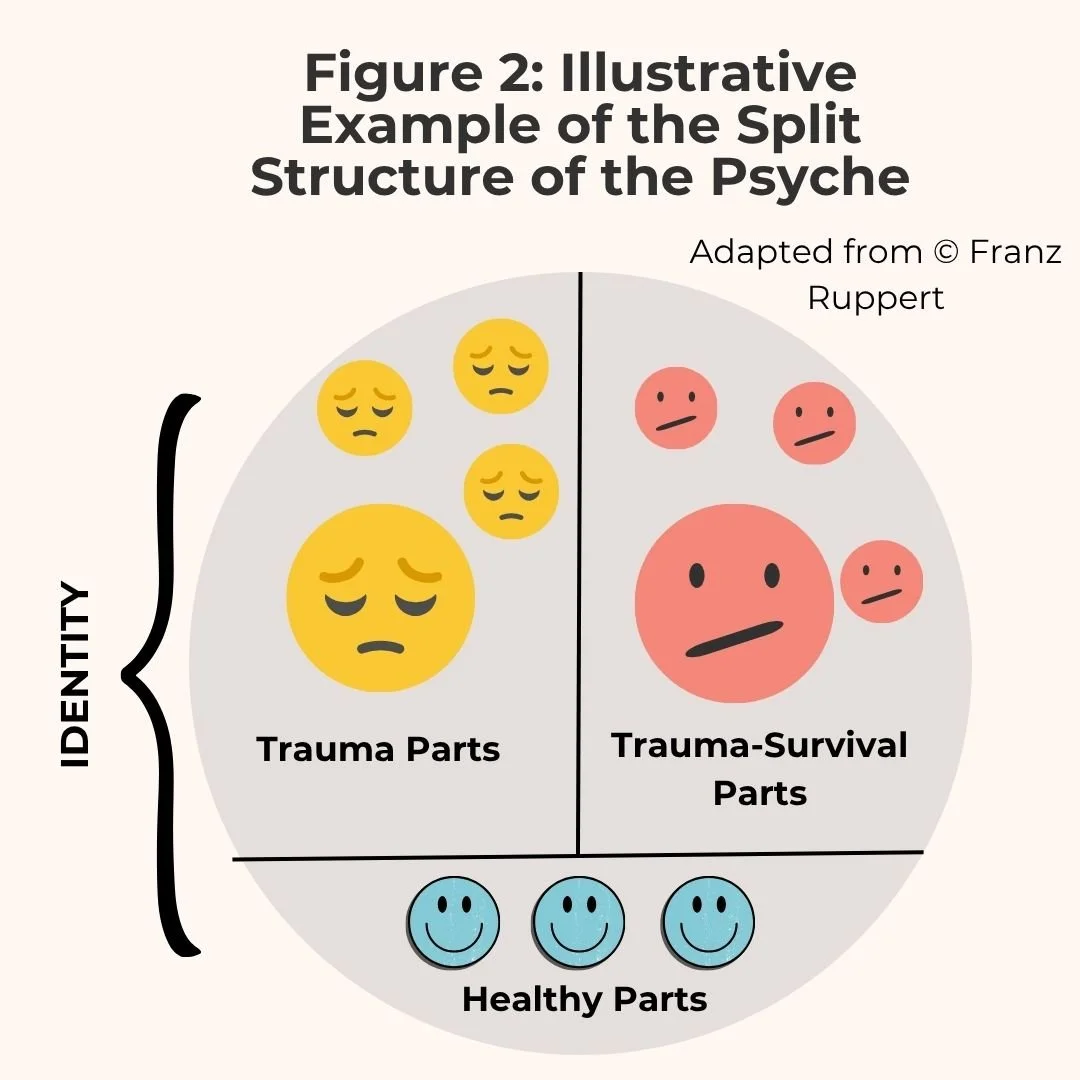
The illustrations show that the proportions of healthy parts, survival parts, and trauma parts can differ greatly from one person to another. How these different parts develop depends on how an individual perceives and processes an experience. This is influenced by many factors, including the nature and timing of a traumatic experience, the internal and external resources available at the time, our attachment experiences and the presence of supportive relationships. Also previous and continuing healing experiences shape how we respond to overwhelm and how our psyche develops and organizes itself over time.
Important to recognize is that healthy parts are always present, regardless of how much trauma a person has experienced. Trauma can significantly affect our access to these parts and may cause survival parts and trauma parts to become more dominant in our everyday experience, but our capacity for connection, curiosity, authenticity, and self-awareness remains part of our identity.
The healing process is therefore about strengthening our connection with these existing aspects of ourselves and gradually integrating the parts of our identity that became fragmented through trauma.
The illustrations are meant to provide a visual way of understanding that trauma affects each person differently, and that the relationship between these inner parts can gradually change throughout the healing process. As clients strengthen their healthy parts and begin to integrate previously fragmented trauma and survival parts, their internal experience often becomes more coherent, connected, and self-directed.
When different parts of ourselves become activated
Understanding the split structure of the psyche also helps explain why we sometimes feel as though different parts of us take over in different situations. During everyday life, we naturally move between different parts of ourselves, that means between our healthy parts, survival parts and trauma parts. This is a normal function of our psyche and nervous system. Depending on the situation we are in, different parts may become more present in order to help us adapt, protect ourselves, or respond to what is happening around us.
When we are triggered or feel dysregulated, we may temporarily experience the world through a survival part or a trauma part. In these moments, the feelings, beliefs, and body sensations connected to that part can feel very real and overwhelming. We may feel as if this is "who we are". At the same time, these experiences are rarely completely black and white. It is possible for different aspects of our I to be active simultaneously. For example, our healthy parts may cognitively understand what is happening and recognize that we are experiencing a trauma response, while our body and emotional experience remain deeply rooted in survival. We may "know" that we are safe, yet still feel intense fear, shame, or helplessness. This reflects the fragmented nature of the psyche, where different parts can hold different realities at the same time.
However, a triggered part is only one aspect of our fragmented I. It does not represent the whole of who we are. Likewise, having access to healthy parts does not necessarily mean that our trauma and survival parts are no longer activated. Healing is not about replacing one state with another, but about gradually strengthening our capacity to remain connected to our healthy I while meeting the experiences carried by our trauma and survival parts with awareness, compassion and support.
Understanding the concept of ''identification''
In IoPT, identifications are one form of survival strategy that can develop in response to traumatic experiences. They can be understood as the unconscious process of taking on aspects of another person, such as their beliefs, feelings, attitudes, expectations, or trauma-related perspectives. These identifications often develop in early childhood, particularly within relationships with our primary caregivers, and can become deeply connected to how we experience ourselves and the world.
However, identifications do not only develop in relation to our primary caregivers. We may also identify with a perpetrator; or with groups, sports clubs, or brands that provide us with a sense of belonging, identity, or safety. Especially when we have little connection to ourselves or feel an inner emptiness and disconnection, identifying with something or someone outside of ourselves can help fill this void and provide us with a sense of identity. Identifications can also extend across generations, for example through identification with family members we have never personally known.
To understand why identifications develop, it is important to consider the role of attachment and survival in childhood. Our connection to our primary caregivers is essential for our physical and emotional survival. When our parents are unavailable, rejecting, frightening, or unable to meet our emotional needs, we unconsciously adapt to the relationship to keep this essential connection (often at all cost). One way this can happen is by taking on aspects of our parents’ beliefs, feelings, or attitudes and experiencing them as though they were our own.
There are many different ways in which such identifications can develop, depending on the experiences and dynamics within the family. For example:
A child may experience being unwanted, rejected, or as though their existence is a burden to a parent. The child may then develop beliefs such as "I should not exist,""There is something wrong with me," or "I am not wanted." Later in life, this may be connected with chronic shame, self-doubt, self-rejection, or a deep difficulty in feeling that they have a right to exist and take up space. These dynamics can also become connected with self-destructive or self-harming patterns. From an IoPT perspective, the child has internalized the rejecting or destructive attitude they experienced from the parent, carrying it as part of their own fragmented I.
A parent may unconsciously rely on their child to provide them with a sense of aliveness, purpose, emotional stability, or meaning. The child may then begin to identify with the parent's needs and experience them as their own. Instead of being able to recognize, "My mother needs me to make her feel alive" or "My mother is relying on me to give her emotional support," the child may internalize the message that their purpose is to fulfil the parent's needs. In this way, the child's sense of identity can become organized around the role they have taken on within the relationship. Later in life, this identification may continue to influence how the person experiences themselves and their relationships. They may feel most valuable when they are needed, experience guilt when they prioritize themselves, or automatically focus on other people's needs before becoming aware of their own. The underlying identification may remain largely unconscious: "My role is to take care of others," "My needs are less important," or "My existence has value when I am useful to someone else."
A child may repeatedly experience a parent’s fear, anger, shame, or self-rejection and gradually begin to experience these emotional states as part of themselves. For example, a highly anxious or fearful parent may communicate, directly or indirectly, that the world is dangerous and that the child cannot be trusted to handle life. The child may then develop an identification with this fear and later experience themselves as fragile, unsafe, or incapable, even in situations where they are objectively safe and capable.
A child may also adapt to a parent who is highly critical, controlling, or demanding by internalizing the parent’s standards and judgments. They may come to believe, "I am only worthy when I perform well," "I must not make mistakes," or "I have to be perfect to be loved." Later, this can contribute to chronic self-criticism, perfectionism, anxiety, or a persistent feeling of never being good enough.
These examples illustrate how identifications can develop through unhealthy and traumatizing experiences. As children, it can be very difficult to recognize that the problem lies within the parent or caregiver. As a child we are not able to fully understand, "My parent is rejecting me" or "My parent is unable to give me the love and safety I need." Instead, the child may unconsciously adapt by making the experience about themselves: "There is something wrong with me," or "I have to be a certain way to be loved/accepted/tolerated..." In this way, what originally belonged to the relationship becomes deeply woven into the child's developing sense of self.
This can create the painful experience that a part of us hates, rejects, or does not want contact with ourselves. From an IoPT perspective, this is understood as a part of the fragmented I carrying such identifications. This part may continue to experience the world through the perspective that developed in response to earlier relationships, even when the original situation has long passed. Identifications can therefore become deeply embedded in our sense of who we are. We may experience certain beliefs, feelings, or ways of relating as simply "who I am," without recognizing that they may have developed through an earlier relationship and originally belonged to someone else.
These dynamics can become visible during self-encounters. When an identification becomes apparent, it is possible (if the client feels ready and it is appropriate within the process) to explore this through an identification resonance. This happens by either adding a resonator or choosing an object/floor marker that represents the identified person. This can support the client in exploring what belongs to their own I and what may have been taken on from another person. Through this process, the identification may become more conscious, creating space to recognize what belongs to our own I and what has been taken on from another person. From an IoPT perspective, coming into contact with this truth can allow the energy held within the identification to release, as the psyche begins to reorganize around a clearer sense of what is truly our own. Recognizing identifications is an essential part of understanding how the fragmented I can influence our experiences in the present, and how intergenerational trauma is passed down from generation to the next.
In the following FAQ section, I will explore some of the most common questions about the IoPT therapeutic process, different ways of working with IoPT, and what to expect when working with a self-encounter.
Frequently Asked Questions
-
Every IoPT session is unique and shaped by the individual process of the person. However, the sessions follow a similar structure that creates a safe and supportive framework for self-exploration.
At my practice, an IoPT session is usually scheduled for 90 minutes. The self-encounter itself often takes around 60 minutes, although the duration can vary depending on what emerges during the process.
Usually, the format in my sessions follows this structure:
1. Check-in and forming an intention
At the beginning of the session, we take time to connect and check in how you are feeling and what you’d like to focus on in this session. Zou take the time to formulate an intention that reflects what you wish to explore.
The intention is your personal starting point for the self-encounter and supports you in strengthening a sense of healthy autonomy and self-contact.
2. The self-encounter
After the intention has been formulated, the self-encounter begins. Depending on whether we work individually or in a group setting, this process takes place through self-resonance using floor anchors or objects, or through resonance with other participants.
Throughout the process, I support you in staying connected with yourself and in exploring what emerges at a pace that feels manageable for you.
3. Therapeutic guidance
My role as a therapist is to provide a safe and supportive space, offer co-regulation when needed, and support you in reconnecting with your healthy I. This means helping you remain present with your experience without becoming overwhelmed by it.
I place particular importance on nervous system regulation throughout the process and continuously adapt the pace according to what feels safe and appropriate for you.
4. Integration and grounding
After the self-encounter, we take time to integrate what emerged during the session. This may include reflection, grounding or somatic practices, or other tools that support nervous system regulation and self-connection.
You remain in charge of your process
A central principle of IoPT is that you have full autonomy over your own process.
You can pause, slow down, ask questions, or stop the process at any point if something feels too overwhelming or simply does not feel right. There is no pressure to continue, share, or explore anything before you feel ready.
-
The self-encounter, also often referred to as resonance process, always starts with the client formulating their intention. The intention is written down so that it becomes visible and tangible during the process. When working in a physical setting, this is usually done on a board. In online sessions, the intention can be written in the chat or another shared space.
The client then selects up to three elements from their intention that they would like to explore further. These elements can be individual words or punctuation marks. In a physical setting, these are written on separate notes and placed in the room. In an online session, they are marked separately in the chat.
In an individual session, the client chooses objects or floor markers to represent the selected elements and places them in the space. These elements then become points of exploration through self-resonance.
In a group session, the client chooses participants who will resonate with the selected elements. The remaining participants stay as observers and witness the process without taking an active role as resonators.
SELF-ENCOUNTER IN A GROUP SETTING:
Once the client feels ready, the resonance process begins.
The resonators connect with the element they represent and notice what naturally emerges within them. This may include emotions, body sensations, impulses, movements, images, or thoughts. They share their experience from the resonance without analysing, interpreting, or trying to find an explanation.
The client decides where they would like to begin exploring and which questions they would like to ask. For example, they may ask:
"What do you resonate with?"
"Is there a certain age that you sense?"
"What are you experiencing in your body?"
As the resonators share their experiences, the client remains in contact with themselves and observes what resonates internally. They may notice emotions, memories, body sensations, or associations arising within them, and they reflect these back into the process. For example, the client may recognize a familiar feeling and say: "Yes, I know this feeling of panic. It often appears especially in the evenings." Or they may notice a connection to a specific life experience and share: "What emerges in me when I hear this is the time when my parents separated, and I felt completely alone and overwhelmed."
Through this dialogue, different inner experiences and dynamics can become visible. The client can explore how different parts of themselves relate to the intention and begin to develop a deeper understanding of their inner world.
An important aspect throughout the self-encounter is that the client remains connected to their own experience. They only take in what feels meaningful and true for them.
SELF-ENCOUNTER IN AN INDIVIDUAL SESSION:
When working 1:1, the client chooses objects or floor markers to represent the selected elements from their intention and places them in the room. The client then enters into self-resonance with these elements, exploring what emerges internally through emotions, body sensations, thoughts, impulses, or memories.
The therapist supports the process by asking questions that invite deeper awareness, such as:
"What do you notice when you are in contact with this part?"
"What do you resonate or sense?"
"Does a certain age or time period come up?"
"What happens in your body as you connect with this?"
Different clients engage with self-resonance in different ways. Some prefer to spend a few moments quietly sensing and exploring internally before stepping out of resonance and reflecting together with the therapist. Others prefer to remain in resonance while communicating what they experience. Both approaches are possible, and the process is adapted to what feels supportive for the individual.
-
The short answer is: IoPT works very well both online and in person. The therapeutic principles remain the same regardless of the setting, and many people experience deep and meaningful self-encounters in both formats.
At the same time, each format has its own practical characteristics, and people often have individual preferences depending on their circumstances, location and what helps them feel most comfortable and supported.
WORKING IN PERSON:
During in-person sessions, we have the opportunity to use the therapy room as part of the process. In individual sessions, I provide floor markers, figures, and other objects that can be used to represent different inner parts.
Being together in the same room also allows for direct non-verbal communication. As a therapist, I can more easily observe subtle changes in posture, breathing, movement, and nervous system activation. When appropriate and with the client's explicit consent, gentle supportive touch, such as a hand on the shoulder, may also be used as a grounding and co-regulating resource.
WORKING ONLINE:
Online IoPT sessions follow the same therapeutic process. Instead of using materials from my therapy room, clients usually choose objects that are available in their own home to represent the different inner parts. Some people use cushions, books, cups, small figurines, stones, or other everyday objects. Others prefer working without objects, and go directly in resonance with each part.
For many clients, working from their own home creates a greater sense of safety and familiarity. Being in a well-known environment can help the nervous system feel more settled, and some people appreciate having immediate access to their own comforting objects, favourite blanket, pet, or other personal resources after the session.
Online sessions also make IoPT accessible regardless of geographical location, allowing people to continue working with a therapist they trust even if they move or live in another country.
-
Choosing between individual and group sessions is a very personal decision. Both formats are based on the same IoPT principles and can support meaningful self-exploration. The question is less about which format is "better" and more about which setting feels most supportive and appropriate for you at this point in your process.
INDIVIDUAL SESSIONS:
Individual sessions may feel supportive if you:
Prefer a private and dedicated therapeutic space focused entirely on your own process.
Would like more time for individual reflection, psychoeducation, and integration.
Feel more comfortable exploring vulnerable topics in a private setting.
Would like the opportunity for self-resonance without the added intensity of several parts being resonated at once, which can sometimes feel overwhelming in a group space.
Prefer a quieter and more contained therapeutic experience.
GROUP SESSIONS:
Group sessions may feel supportive if you:
Appreciate the opportunity to explore your inner world through resonance with other participants.
Find it helpful to directly engage with resonators and ask questions to specifically explore dynamics between your different parts that are represented simultaneously.
Find connection with others and the experience of community support.
Appreciate witnessing other people's processes and discovering insights that may also relate to your own experiences.
Would like to experience the unique learning and self-awareness that can come from resonating for others.
-
IoPT can support people in developing a deeper understanding of themselves, their inner parts, and the ways in which past experiences continue to influence their present life. The process is highly individual, and every person's healing journey unfolds in its own way and at its own pace. What emerges during a self-encounter cannot be controlled or forced; instead, we create space to gently explore what is ready to come into awareness.
The following points reflect my personal therapeutic approach and the areas where I place particular focus when supporting clients:
Strengthening connection with our Healthy Parts and internal resources, including our capacity for curiosity, reflection, self-awareness, authenticity, and being present with ourselves.
Processing and integrating traumatic experiences, including emotions, body sensations, and unexpressed emotional or somatic responses that could not be fully processed at the time they occurred.
Developing a stronger sense of identity and inner coherence by exploring central questions such as: Who am I? What do I feel? What do I need? What do I want? What is true for me?
Developing and strengthening our own will: reconnecting with our own wishes, desires, choices, boundaries, and the ability to make decisions that are aligned with ourselves.
Understanding survival strategies and protective patterns, including how our thoughts, emotions, behaviors, relationship patterns, and bodily responses have developed as adaptations to overwhelming experiences.
Recognizing the connection between past experiences and present-day struggles, especially how early childhood trauma, attachment experiences, and relational dynamics can influence our sense of self and our way of relating to ourselves and others.
Coming into deeper contact with our body, including learning to notice bodily sensations, emotions, impulses, and signals that may previously have been disconnected or difficult to access.
Supporting nervous system regulation and developing self-regulation capacities, including learning how to stay present with difficult emotions and experiences while maintaining connection with oneself.
Building capacity for co-regulation and safe connection, experiencing a supportive therapeutic relationship where difficult inner experiences can be explored without being overwhelmed by them.
Exploring and integrating Trauma Parts, Survival Parts, and Healthy Parts, developing a more compassionate and connected relationship with different aspects of ourselves.
Developing greater self-awareness and self-understanding, including recognizing inner conflicts, patterns, and unconscious dynamics that influence our lives.
Cultivating self-compassion and a kinder relationship with ourselves, especially towards parts that carry shame, fear, pain, or self-rejection.
Gaining clarity around relationships and relational patterns, including understanding attachment dynamics, boundaries, and ways of creating healthier and more authentic relationships.
Creating more freedom and choice in life, as increased awareness and integration can help us respond to life from a more grounded and connected place rather than being guided primarily by our unconscious survival strategies.
-
One of the strengths of IoPT is that the process does not require explicit memories of traumatic experiences. Many people worry that they cannot work on their trauma because they do not remember specific events from their childhood. However, traumatic experiences are often stored as implicit (unconscious) memories, i.e. emotions, body sensations, beliefs, impulses, and nervous system responses.
Through the Intention Method and resonance, IoPT allows us to access and explore unconscious and preverbal experiences that may have shaped our identity, even when we do not have a conscious memory of them. This can include experiences from very early developmental stages, such as experiences from our time in the womb, birth, or the first years of life.
Having little or no memory of childhood often indicates that the nervous system experienced a level of overwhelm and adapted by disconnecting from certain experiences. Dissociation and reduced access to memories are therefore protective survival responses.
-
A common fear when starting IoPT therapy is the idea that healing requires reliving everything that happened or experiencing all painful emotions again in their original intensity.
In IoPT, the aim is not to recreate traumatic experiences or overwhelm our nervous system. The Intention Method provides a framework that is set by the client themselves. By choosing your own intention, you decide what you would like to explore, and the process unfolds in relation to what emerges from that intention.
Our psyche has its own capacity for self-regulation. We cannot force certain experiences to appear, and we cannot force integration to happen at a specific pace.
When trauma or survival parts emerge with strong emotions or body sensations, you remain in charge of how deeply you want to engage with these experiences. You may, for example, come into contact with a feeling or body sensation for a brief moment and then create some distance from it again. If you find it difficult to come out of a state of strong activation, you are not expected to manage this on your own. As your therapist, I support you in finding your orientation and connection with yourself again and in regulating your nervous system. In this way, your nervous system can gradually become more able to stay in contact with emerging emotions and body sensations without becoming overwhelmed by them. Feeling more or experiencing something more intensely is not necessarily better. What matters is slowing down, noticing what is present, and staying connected with yourself throughout the process.
-
When we begin to turn our attention towards our inner experiences, emotions, and body sensations, it is possible that certain symptoms or feelings temporarily become more noticeable. This can happen because we are becoming aware of experiences that were previously suppressed, disconnected from, or outside of our conscious awareness.
Sometimes we may experience immediate relief, clarity, or a sense of connection after a session, while other times we may notice that emotions or body sensations become more intense before settling. From an IoPT perspective, these are often not new symptoms, but rather old feelings, and sensations that are becoming more accessible and can now be explored and integrated.
At the same time, healing is not about forcing ourselves to relive painful experiences or feeling everything at once. Every person's healing journey is unique, and our psyche and nervous system have their own pace. In my work, I therefore place a strong focus on nervous system regulation, grounding, and strengthening internal resources throughout the process.
After a self-encounter, I generally recommend creating space for rest, self-care, and a slower pace if possible, as the integration process continues after the session.
-
IoPT can support healing by bringing unconscious trauma-related experiences into conscious awareness and creating opportunities for the brain, nervous system, body, and sense of self to experience something different. Several aspects of the process may contribute to this.
The intention directs attention. It directs attention toward something that is meaningful to the client and activates material that may otherwise remain outside conscious awareness. From a psychological and neurobiological perspective, attention, expectation, memory, emotion, and bodily perception are deeply interconnected. Within IoPT, the intention can therefore be understood as the starting point for bringing an inner reality into conscious exploration.
Resonance can make inner psychological dynamics more visible, especially processes that have developed in response to traumatic experiences. Through resonance, aspects of our inner experience that have previously remained outside conscious awareness can become accessible to conscious exploration. As these experiences become more differentiated and can be noticed, named, and felt within a greater sense of safety, we can begin to process and integrate what was previously suppressed, fragmented, or disconnected from our awareness.
Conscious experiencing creates opportunities for integration. When emotions, sensations, memories, and survival responses can be experienced within sufficient safety, they may no longer need to remain outside conscious awareness. From an IoPT perspective, this can allow trauma-related energy that has been stored in trauma parts to release and reorganize.
The nervous system can experience something different. Through co-regulation, presence, and a sufficiently safe therapeutic relationship, the client can approach difficult experiences while remaining connected to the present. Over time, repeated experiences of safety and regulation can contribute to changes in how the nervous system responds to previously threatening situations.
The relationship with our inner parts can change. As we become more aware of our survival and trauma parts, we can gradually begin to differentiate between what belongs to the present moment and what is connected to experiences from the past. The two can become deeply entangled within the psyche, so that something happening in the present may evoke feelings, body sensations, beliefs, or expectations that originated in an earlier experience. As these different layers become more conscious, we can begin to recognize, "This is what is happening now, and this is what is being activated from my past." This differentiation can create more space to respond to the present from our Healthy Parts rather than automatically responding from an old survival pattern.
At the same time, there is still much we do not fully understand about how healing occurs. Consciousness, energetic aspects, and the complexity of our human experience continue to raise profound questions. What we can observe is that therapeutic processes can create meaningful change, even when we cannot yet explain every aspect of how or why this happens. Perhaps this is also part of what makes healing so fascinating: there is still so much we have yet to understand..
Finding your own path to healing
In my view, exploring trauma and the way our psyche and nervous system respond to overwhelming experiences is often a complex, challenging but also deeply beautiful and fascinating process. This process of inner self-exploration can activate our enormous healing capacities, open up new possibilities and transformative life changes. When we begin to recognize that our thoughts, emotions, bodily responses, and patterns have developed for a reason, we can learn to meet ourselves with greater understanding and compassion. What once felt like an unchangeable part of who we are can become something we can explore and relate to differently.
In this way, healing does not mean that difficult emotions or experiences will never arise again. It means that we are developing a deeper capacity to understand what is happening within us, to recognize what belongs to the past and what belongs to the present, and to remain more connected with ourselves when difficult experiences arise. Over time, this can create more space for choice, self-compassion, regulation, and a stronger connection with our own identity.
While IoPT is great therapeutic modality, it may not be the right therapeutic approach for everyone. We all have different needs, histories, and ways of relating to therapeutic work, and finding an approach that feels appropriate and supportive is an important part of the healing process.
This article reflects my personal understanding, experience, and way of working with IoPT. Different IoPT therapists may have different perspectives, backgrounds, and approaches. My work is particularly informed by my focus on the nervous system and somatic processes, as well as my background in mindfulness and meditation and many years of personal work with IoPT and other holistic modalities.
I hope this article has given you greater clarity and a deeper understanding of IoPT, its therapeutic approach, and the ideas and principles behind it. If you are curious about exploring IoPT for yourself, you are warmly welcome to reach out. I offer online sessions for clients around the world, as well as in-person sessions in Oslo. You can also book a free 30-minute introductory meeting to get to know me, ask any questions you may have, and get a sense of whether working together could feel right for you. And if you have thoughts, questions, or personal experiences you would like to share, I would love to hear from you in the comments below . you will also find questions for reflection further below 🙏
Thank you for being here.💕
Julia
✏️ Questions for Reflection:
Which feelings, beliefs, or inner voices tend to appear repeatedly in certain situations?
What beliefs or expectations about yourself, others, or relationships might you have learned from your parents or caregivers that still shape your life today?
Where in your life do you feel most connected with your authentic self?
Is there anything that you have become more curious about through reading this article?